The Education System in Ethiopia—A Student’s Guide
Ethiopia’s education system has grown a lot over recent decades. This guide explains how the system is arranged, what students experience at each stage, and the main features and challenges so that students can understand how schooling works in Ethiopia and what to expect.
1. Quick overview—the big picture
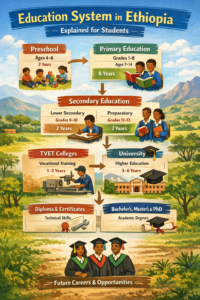
Ethiopia’s formal education system is typically described as a 4+4+2+2 structure:
-
Pre-primary (kindergarten, optional)
-
Primary / Basic education: Grades 1–8 (often split into Grades 1–4 and 5–8)
-
Secondary education: Grades 9–12 (split into lower secondary 9–10 and upper secondary 11–12)
-
Higher education/TVET (technical and vocational education and training) and universities after grade 12.
Children normally start primary school at age 7 and the usual academic year runs from September to July (this follows the government school calendar).
2. Pre-primary (Kindergarten / Early Childhood Education)
Pre-primary education (ages roughly 4–6) is not universally available. Where it exists, it’s often run by private providers, NGOs, or faith-based groups. Pre-primary aims to prepare children for Grade 1 and to develop early language, motor, and social skills. Access varies widely by region—in many rural areas there are few or no kindergarten options.
3. Primary / Basic Education (Grades 1–8)
Structure
Primary or basic education covers Grades 1–8 and is usually understood as two cycles:
-
Grades 1–4—early basic literacy and numeracy
-
Grades 5–8—deeper subjects and preparation for secondary school
Primary education is the main focus of government efforts to increase enrollment and literacy. Public primary schooling is provided free of charge in government schools.
What you study
Young learners start with reading, writing (in local languages or Amharic in many places), basic math, social studies, and life skills. As students move to Grades 5–8, the subject list expands to include science, civics, basic English, and sometimes introductory technical or agricultural topics depending on the school and region. The National Curriculum Framework defines learning outcomes and competency levels for KG–Grade 12 and emphasizes active learning and competency-based approaches.
Exams and certification
At the end of Grade 8 students usually take a primary leaving exam (regional/national assessment) that determines progression to secondary education or placement in TVET programs. Completing Grade 8 is an important milestone for many families.
Challenges at primary level
Although enrollment rates have improved, dropout rates and inequalities remain—especially in pastoral and remote regions (e.g., Somali, Afar) where school access and completion are lower than in cities. Rural schools may lack trained teachers, classrooms, and textbooks.
4. Secondary Education (Grades 9–12)
Lower secondary (Grades 9–10)
-
Often called general secondary (first cycle)
-
Covers broader subject matter; students take an exam at the end of Grade 10
-
The curriculum becomes more rigorous, and instruction in English increases, particularly in science and math.
Upper secondary / Preparatory (Grades 11–12)
-
Grades 11–12 prepare students for higher education or TVET.
-
At this stage, students may choose to focus on sciences or social sciences, depending on their interests and the school’s offerings.
-
Final national exams at the end of Grade 12 are used for university entrance and to award the national leaving certificate. Passing a set number of subjects is required for higher education admission.
TVET and alternatives
Students who do not continue to university can enroll in TVET (Technical and Vocational Education and Training) programs that offer practical skills in trades like mechanics, construction, agriculture, hospitality, and ICT. TVET is an important route for employment and for students who prefer hands-on learning.
5. Higher education
Ethiopia’s higher education sector includes universities, colleges, and specialized institutes offering undergraduate and postgraduate programs. Admission is typically competitive and based on Grade 12 results and national entrance criteria. The government and universities are expanding capacity, but demand still exceeds supply in many fields.
6. Language of instruction
Early grades often use regional languages or Amharic, depending on the region and community. English becomes the medium for many subjects (especially science and mathematics) at the secondary level and in higher education. Language policy aims to balance mother-tongue instruction with preparing students for higher education and global communication.
7. Curriculum and teaching approach
The Curriculum Framework for Ethiopian Education (KG–Grade 12) emphasizes:
-
Competency-based learning and active student participation
-
Inclusion (gender, learners with special needs)
-
Integration of life skills, civics, ICT basics, and health topics (e.g., HIV awareness, environmental education)
-
Teacher training and orientation to new methodologies are central to implementation.
This means classrooms are expected to move from teacher-centered lectures toward activities that build skills and problem-solving.
8. Major challenges and reforms
Key challenges
-
Regional inequality: Urban centers (like Addis Ababa) have much better access, trained teachers, and facilities than remote or pastoral regions.
-
Dropout and repetition: Many students leave school before Grade 8 or repeat grades, especially where economic pressures force children to work.
-
Teacher shortages and training needs: Quality depends on teacher competence; rolling out competency-based approaches requires large-scale teacher training.
-
Capacity for higher education: Limited university seats and resources mean many qualified students cannot access desired programs.
Reforms and responses
The Ministry of Education and partners have focused on expanding basic education access, updating the curriculum, promoting TVET, improving teacher education, and using mother-tongue instruction in early grades. International partners and NGOs also support school construction, teacher training, and learning materials distribution.
9. Practical tips for students and parents
-
Start early with reading and numeracy: strong basics in Grades 1–4 make later learning much easier.
-
Use local resources: Community schools, libraries (where available), and radio/NGO programs can supplement learning in remote areas.
-
Plan for English growth: From lower secondary, English becomes more important—practice reading and listening early.
-
Consider TVET: If you like hands-on work, explore TVET options—they lead to practical jobs and local demand for skilled workers.
-
Talk to teachers about exams and progression: Understand Grade 8 and Grade 12 exam requirements early so you can plan subject choices.
10. Where to learn more (official guidance)
-
The Ministry of Education Curriculum Framework (KG–Grade 12) explains national learning goals, curriculum aims, and competency frameworks. This is the go-to official document for curriculum details.
-
International overviews (WENR, Nuffic, Scholaro) provide helpful charts and summaries showing the structure and how it compares internationally.
Conclusion
Ethiopia’s education system aims to give every child basic literacy, numeracy, and life skills through an 8-year primary program and an additional 4 years of secondary study. Progress has been impressive in enrollment, but regional inequalities, teacher training needs, and capacity constraints remain important challenges. For students, focusing on solid basics, choosing subjects carefully in secondary school, and considering TVET options are practical steps to succeed in the Ethiopian education landscape.