
The Ancient History of Ethiopia: From Aksum to Modern Nation
The Birth of an Ancient Civilization

The ancient history of Ethiopia is one of Africa’s most remarkable and continuous civilizational stories. Unlike many regions whose ancient kingdoms vanished without leaving a lasting political identity, Ethiopia preserved its cultural and historical continuity for over two millennia. At the heart of this legacy stands the powerful Kingdom of Aksum, one of the great civilizations of the ancient world.

Located in the northern highlands of present-day Ethiopia and Eritrea, Aksum emerged around the 1st century CE and flourished until approximately the 7th century CE. During its height, Aksum was recognized as one of the four great powers of its time, alongside the Roman Empire, Persia, and China. Its strategic location near the Red Sea allowed it to dominate trade routes connecting Africa, Arabia, India, and the Mediterranean world.
The Rise of the Kingdom of Aksum
The Kingdom of Aksum grew from earlier civilizations such as the Dʿmt kingdom (c. 10th–5th century BCE), which had already established agricultural systems, monumental architecture, and trade networks. However, it was Aksum that elevated the region into an international power.
Political and Administrative Strength
Aksum was ruled by kings known as “Negus” (meaning king). These rulers centralized authority and built a stable administrative system that allowed the kingdom to expand its influence into parts of modern-day Sudan, Eritrea, Yemen, and Saudi Arabia.
One of Aksum’s greatest rulers was King Ezana, who reigned during the 4th century CE. Under his rule, Aksum reached its territorial and economic peak. Ezana is particularly significant because he converted to Christianity, making Aksum one of the earliest states in the world to officially adopt the Christian faith.
Aksum and Global Trade Networks
Aksum’s wealth and power were built on trade. Positioned between the Nile Valley and the Red Sea, the kingdom became a commercial bridge linking Africa with the Middle East and Asia.
Major Trade Routes
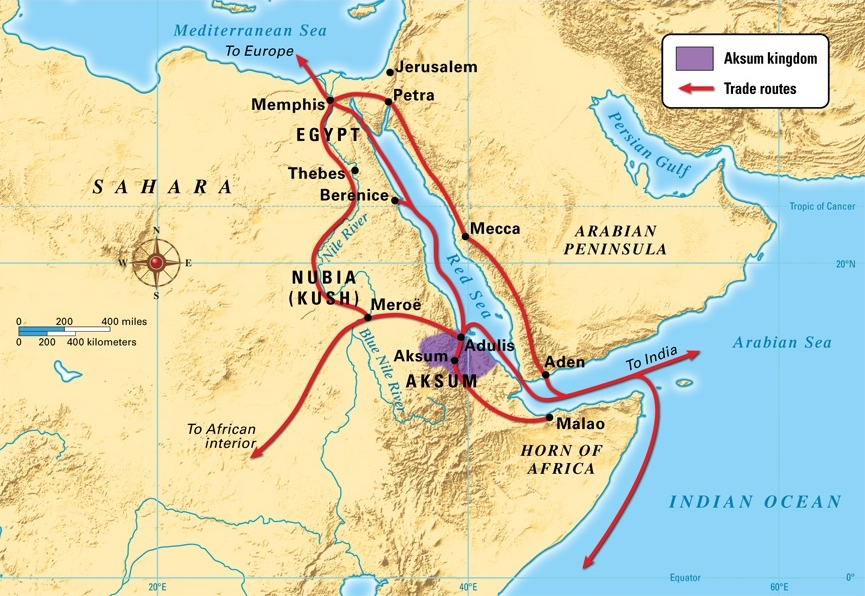
Aksum controlled the port of Adulis on the Red Sea coast. From this port, goods traveled to Egypt, Rome, Persia, and India. The kingdom exported:
- Gold
- Ivory
- Frankincense and myrrh
- Exotic animals
- Slaves
In return, Aksum imported:
- Silk from Asia
- Wine and olive oil from the Mediterranean
- Glassware and luxury goods
Aksum was among the few African civilizations to mint its own coins. These gold, silver, and bronze coins bore inscriptions in Greek and later in Ge’ez, demonstrating both international engagement and local identity. The use of coinage also highlights the kingdom’s advanced economic system. 
The Introduction of Christianity
One of the defining moments in Ethiopian history was the adoption of Christianity in the 4th century CE. According to tradition, Christianity was introduced by a Syrian missionary named Frumentius, who later became the first bishop of Aksum.
King Ezana’s conversion transformed Aksum into one of the earliest Christian states, even before much of Europe had adopted Christianity. The Ethiopian Orthodox Church traces its roots directly to this period and remains a central part of Ethiopian identity.
This early adoption of Christianity gave Ethiopia a unique historical identity. While surrounded by regions that later became predominantly Islamic, Ethiopia maintained a distinct Christian tradition that shaped its art, literature, and political ideology.
Monumental Architecture: The Stelae of Aksum
One of the most iconic symbols of Aksumite civilization is its massive stone stelae (obelisks). These towering granite structures were erected as grave markers for kings and nobles.
The largest stela once stood over 30 meters tall and weighed hundreds of tons. These monuments reflect advanced engineering skills and artistic sophistication. They were carved with detailed patterns that resembled multi-story buildings, complete with doors and windows.
The stelae demonstrate the kingdom’s ability to organize labor, transport massive stones, and execute precise craftsmanship—evidence of a highly developed society.
The Decline of Aksum
By the 7th century CE, Aksum began to decline. Several factors contributed to its weakening:
- Environmental degradation and soil exhaustion
- Shifts in trade routes
- The rise of Islamic powers in Arabia, which altered Red Sea commerce
- Internal political instability
As maritime trade moved increasingly toward Islamic-controlled territories, Aksum lost much of its economic dominance. Gradually, political power shifted southward into the Ethiopian highlands.
Although the kingdom declined, it did not disappear completely. Its cultural and religious traditions continued to influence the emerging Ethiopian state.
The Zagwe and Solomonic Dynasties
After Aksum’s decline, the Zagwe dynasty (c. 12th–13th centuries) ruled parts of Ethiopia. The most famous legacy of this period is the rock-hewn churches of Lalibela, carved directly into solid rock.

These churches remain active places of worship and are masterpieces of medieval architecture. They symbolize the continuation of Ethiopia’s Christian tradition after Aksum.
In 1270, the Solomonic dynasty claimed descent from the biblical King Solomon and the Queen of Sheba. This claim reinforced Ethiopia’s unique identity as a kingdom with ancient and sacred legitimacy. The Solomonic rulers governed Ethiopia for centuries, maintaining continuity between ancient and medieval traditions.

Ethiopia and Islamic Expansion
During the 7th century, early Muslims found refuge in Aksum during the time of Prophet Muhammad. This event established a long-standing relationship between Ethiopia and the Islamic world.
Despite later conflicts between Christian and Muslim states in the region, Ethiopia maintained a degree of independence. Its mountainous geography helped protect it from foreign invasions, allowing it to preserve its political autonomy when many African regions fell under foreign rule.

Ethiopia in the Modern Era
Ethiopia’s ancient legacy played a critical role in shaping its modern identity. Unlike most African countries, Ethiopia was never fully colonized. Although it was briefly occupied by Italy from 1936 to 1941, it successfully resisted European colonial ambitions during the 19th century.
The victory at the Battle of Adwa in 1896 symbolized Ethiopia’s determination to defend its sovereignty. This resistance reinforced the idea that Ethiopia was a continuation of an ancient, independent civilization.
In 1974, the monarchy ended, and Ethiopia transitioned through revolutionary and socialist periods before becoming the Federal Democratic Republic of Ethiopia in 1995.
Ethiopia’s Unique Historical Identity
Several elements make Ethiopia’s historical identity distinct:
1. Continuous Civilization
From Aksum to modern Ethiopia, there has been remarkable cultural continuity.
2. Early Christian Heritage
Ethiopia is one of the oldest Christian nations in the world, with traditions that predate much of Europe’s Christianity.
3. Indigenous Script and Language
The Ge’ez script, developed in ancient times, is still used in religious contexts today.
4. Resistance to Colonization
Ethiopia’s successful resistance to European colonization strengthened its national pride and international reputation.
The Legacy of Aksum Today
The ruins of Aksum, the ancient stelae, and Ethiopia’s enduring religious traditions serve as living reminders of its ancient greatness. The historical narrative of Ethiopia is not simply about a lost civilization—it is about a civilization that transformed and survived.
Modern Ethiopia carries the memory of Aksum in its culture, national symbols, and religious institutions. The ancient trade networks, monumental architecture, and political innovations of Aksum laid the foundation for one of Africa’s most enduring states.