Best Free Books & Learning Resources for Ethiopian Students—a practical guide
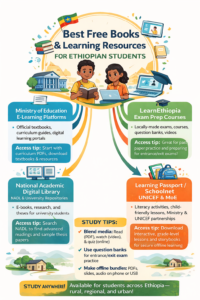
Access to quality learning materials should not be a barrier to success. Whether you are in Addis Ababa, a regional town, or a rural kebele, there are growing free resources—official and community-built—that Ethiopian students can use for school, exam preparation, university courses, and lifelong learning. Below are the most useful free sources, how to access them, and practical tips for getting the most out of each resource.
At-a-glance: the top free resources (quick list)
-
Ministry of Education online platforms and digital library—official textbooks, curriculum frameworks, and e-learning portals.
-
LearnEthiopia—a locally focused platform with many free courses and exam-prep materials.
-
Ethiopia—Learning Passport/Schoolnet—child- and school-focused reading and learning resources provided with partners (Ministry, UNICEF, Microsoft).
-
National and university digital libraries (NADL, institutional repositories)—academic e-books, theses, and research collections.
-
Open Educational Resources (OER) & MOOCs—global OERs and MOOCs that align with Ethiopian curriculum goals (useful for extra practice and advanced topics).
Why use these particular resources?
-
Official alignment: Ministry resources and the national digital library contain materials that follow the Ethiopian curriculum and are often the authoritative source for textbooks, syllabi, and exam blueprints. This reduces confusion about which edition or curriculum a teacher expects.
-
Local relevance: Platforms like LearnEthiopia provide exam-focused courses (entrance/exit exams, grade-level review) tailored for Ethiopian students’ real needs. These are often authored or curated by local educators and reflect exam patterns.
-
Accessibility & partnerships: Initiatives such as Learning Passport are designed to reach children with limited classroom access and include interactive and offline-capable materials developed in partnership with UNICEF and other organizations.
Detailed walkthrough of the best sources
1) Ministry of Education (MoE)—official e-resources and curriculum documents
What to find:
-
Curriculum frameworks, policy documents, and official guidance (used by schools when choosing textbooks and designing lessons).
-
MoE e-learning pages and portals that may host digital textbooks, teacher guides, and learning modules.
How to use:
-
Start with the Curriculum Framework to know the learning outcomes and which topics are examinable in each grade. That helps you prioritize study and choose the correct edition of textbooks.
-
Teachers and students can use the MoE’s e-learning sections to find official lesson plans and digital textbooks where available. If a digital textbook is available from MoE, prefer it for alignment.
Practical tip: If the internet is intermittent, download PDFs (where permitted) from MoE pages and move them to a phone or USB—many MoE documents are published as downloadable PDFs.
2) National Academic Digital Library (NADL) & university repositories
What to find:
-
Scholarly books, theses, reports, and discipline-specific e-books collected centrally for higher-education students. The NADL is a ministry-led effort to collect and collate academic material for students and lecturers.
How to use:
-
Search NADL for course readings, sample theses, and reference books that you cannot find in printed form. Use these for term papers, research projects, or deeper textbook chapters beyond school-level material.
Practical tip: Many universities mirror their most-used readings in their institutional repositories; check your university library page if you’re a higher-ed student.
3) LearnEthiopia—locally curated courses, exam prep & question banks
What to find:
-
Free and paid courses focused on entrance/exit exams, grade-level reviews, and topical revision materials. LearnEthiopia hosts many free basic courses and exam question banks that are tailored to Ethiopian exam formats.
How to use:
-
Use LearnEthiopia for focused exam drills: past-question compilations, timed quizzes, and topic-wise practice. Their “exit exam” and “entrance exam” sections are particularly useful when preparing for university entrance or graduation exams.
Practical tip: If you need interactive lessons, check whether a course has video lectures or downloadable PDFs—combine those with past papers for efficient preparation. https://learnethiopia.com/
4) Ethiopia Schoolnet—Learning Passport & UNICEF partnerships
What to find:
-
Child-friendly reading resources, curricula-aligned modules, and interactive lessons designed for school-age learners, often with offline compatibility through partner apps.
How to use:
-
Great for primary and lower-secondary levels: reading practice, literacy activities, and teacher support materials. Parents and teachers can use Learning Passport’s sequenced lessons to support classroom learning or home study.
Practical tip: Learning Passport often offers structured daily learning plans that are easy to follow during school closures or revision periods.
5) Global OERs and MOOCs—expand beyond the syllabus
What to find:
-
High-quality open textbooks, lecture notes, and MOOCs on subjects like mathematics, physics, computer science, economics, and teacher training. International OER repositories and MOOC platforms often provide free course materials you can adapt to the Ethiopian context.
How to use:
-
Use OER materials to supplement weak areas (e.g., extra calculus practice or advanced biology). MOOCs from reputable universities are excellent for structured learning and certification (sometimes for a nominal fee). Align topics with the MoE curriculum so you learn what’s examinable.
Practical tip: Download video transcripts and slides where possible; these are lighter to keep offline than full video files.
Study strategies using free resources
-
Map resource → curriculum topic: Start with the MoE curriculum; for each unit, note which free source (MoE pdf, LearnEthiopia course, NADL chapter, or an OER) covers that topic best.
-
Use question banks for active recall: After reading a chapter, practice with past papers and LearnEthiopia question sets to test retention.
-
Blend media: Read the official textbook (PDF), watch a short MOOC clip for explanation, and solve a quiz—this mix cements understanding.
-
Make offline bundles: When you have good connectivity, download PDFs, video transcripts, and a few short videos into your phone or SD card so you can study without data.
Accessibility & fairness: what if I have limited internet or no device?
-
Public access points: University libraries and regional education bureaus sometimes provide computer access and printed copies. NADL and MoE documents are designed to be downloadable for offline use.
-
Low-data options: Prefer text PDFs and audio or transcript files over full HD video. Many platforms provide lightweight versions or allow partial downloads.
Final checklist—getting started today
-
Open the MoE curriculum PDF and identify the topics for your current term.
-
Search NADL for any higher-level reading your teacher recommended.
-
Use LearnEthiopia to find past questions and free revision courses for exams.
-
For primary and middle-school learners, check Learning Passport/Schoolnet materials for sequenced lessons.
-
Supplement with free OERs/MOOCs for weak topics or advanced learning.