
How to Create a Winning CV for Ethiopian Job Exams in Ethiopia (Step-by-Step, Complete Flow)
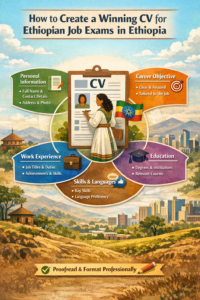
In Ethiopia, many competitive job opportunities—especially in government institutions, education, and large public organizations—follow a structured recruitment process that may include written “job exams,” document screening, and sometimes skill assessments or interviews. Your CV is the first filter. If your CV is unclear, generic, or missing required details, you may be screened out before you ever reach the exam stage.
This guide gives you a practical, Ethiopia-focused CV flow you can follow for job exam applications—aligned with what Ethiopian portals and vacancies typically ask for (personal details, academic background, experience, and document uploads).
1) Understand the “Job Exam” Hiring Context (Why CV Matters)
A “job exam” opportunity usually attracts many applicants. Recruiters often shortlist candidates using CVs and supporting documents first, then invite shortlisted candidates for exams and later stages. That means your CV must do two jobs:
-
Pass the screening (requirements, completeness, clarity)
-
Show strong fit (education + relevant experience + skills for that specific role)
Platforms in Ethiopia also promote job-exam-oriented preparation and structured pathways, which shows how competitive these processes can be.
2) The Complete Flow: From Vacancy Notice to Final CV Upload
Use this exact flow each time you apply:
Step A—Read the vacancy like a checklist
Extract these items and write them on a page:
-
Job title and department/sector
-
Minimum education level and field of study
-
Required years of experience
-
Required documents (CV, transcripts, certificates, ID, etc.)
-
Application method (online form, email, in-person submission)
-
Deadline and file format rules (PDF, size limits, naming style)
Some official portals explicitly instruct applicants to fill required fields accurately and upload clear, readable documents, and they may request your CV in PDF format.
Step B—Collect and organize documents first
Before editing your CV, prepare:
-
Degree/diploma and transcript scans
-
Experience letters (if required)
-
Training certificates
-
ID and other documents requested
This reduces last-minute mistakes and helps you tailor the CV accurately.
Step C—Draft a master CV (long version)
Create one “master CV” that includes everything you have done. You will later shorten and tailor it.
Step D—Tailor the CV for THIS vacancy
Copy the master CV → create a vacancy-specific version.
Step E—Convert to PDF and upload/submit
Many portals accept (or require) a PDF for the CV upload.
3) Winning CV Structure for Ethiopian Job Exam Applications
A strong CV is not “long.” It is well-structured, easy to scan, and aligned to the vacancy.
Learn Ethiopia has the 46 Winning CV templates; you can download it by clicking HERE
Section 1—Header and Personal Information (Ethiopia-ready)
Include:
-
Full name (as per your academic documents)
-
Phone number(s)
-
Email address (professional, active)
-
City/Region (and willingness to relocate if relevant)
-
Optional: LinkedIn (only if professional and updated)
Some Ethiopian portals also collect structured personal details like full name, email, phone number, date of birth, gender, preferred region, and national ID as part of the application flow—so keep your CV consistent with what you will enter online.
Avoid unnecessary personal data (e.g., religion, very private family details) unless the vacancy specifically asks for it.
Section 2—Professional Summary (5–6 lines, targeted)
This is your “hook.” Write it based on the vacancy requirements.
Example (editable):
Graduate of (Field) with (X) years of experience in (relevant area). Skilled in (top 3 job-related skills). Proven experience in (one strong achievement). Seeking to contribute to (organization/sector) through strong (technical + soft skills).
Tip: Use words directly from the vacancy (e.g., “data management,” “financial reporting,” “classroom management,” “project coordination”).
Section 3—Key Skills (bullet points, vacancy-matched)
Split into:
-
Technical skills (software, tools, lab/workshop skills, reporting, teaching methodologies)
-
Soft skills (communication, teamwork, time management)
-
Job-exam helpful skills (documentation accuracy, compliance, attention to detail)
Keep it honest—skills may be tested later.
Section 4—Education (clear and complete)
Use a consistent format:
-
Qualification (BA/BSc/MA/MSc/Diploma/TVET)
-
Field of study
-
Institution
-
Graduation year (E.C. or G.C.—but be consistent)
-
Optional: CGPA/classification if strong
Many education-focused applications also ask for “level of education,” “field of study,” “institution,” and “graduation year,” so this section should be crystal clear.
Section 5—Work Experience (achievement-based)
Use reverse chronological order (most recent first). For each role:
-
Job title, organization, location
-
Dates (month/year – month/year)
-
3–6 bullet points focused on achievements and responsibilities
Write bullets like this (strong format):
-
“Prepared weekly reports for ___, improving accuracy by ___.”
-
“Supported ___ activities by coordinating ___ and ensuring ___ compliance.”
-
“Managed ___ records/data for ___ beneficiaries/students/customers.”
Avoid: long paragraphs. Recruiters scan.
Section 6—Training & Certifications (relevant only)
Include training aligned to the job:
-
Computer skills (Excel, Word, systems)
-
Teaching/assessment training (for education roles)
-
Professional development certificates
Some application portals allow uploading professional development certificates (optional), which indicates these can strengthen your profile.
Section 7—Languages (important in Ethiopia)
List languages with level:
-
Amharic (Native/Fluent)
-
English (Fluent/Good/Fair)
-
Afaan Oromo / Tigrinya / Somali / etc. (as applicable)
Keep levels realistic; interviews/exams may reveal proficiency.
Section 8—References (or “Available upon request”)
Common practice:
-
2 referees (name, position, organization, phone/email) only if requested
-
Otherwise: “References available upon request.”
Follow vacancy instructions if they specify.
4) Formatting Rules That Make Your CV “Exam-Ready”
Use these universal rules:
-
Length: 1–2 pages (fresh graduate), 2–3 pages (experienced)
-
Font: simple and readable
-
Headings consistent (bold, same size)
-
Bullet points aligned
-
No heavy graphics, tables that break on portals, or decorative icons
File format and submission
If a portal says CV upload is PDF, do exactly that.
Practical file naming (clean and professional):FullName_Position_Region_2026.pdf
Example: HanaTesfaye_Teacher_Oromia_2026.pdf
5) Tailoring: The #1 Difference Between Average and Winning CVs
Here’s a simple tailoring method that works:
The “Match 10” rule
From the vacancy, select:
-
4 required skills
-
3 required tasks/responsibilities
-
3 required qualifications/experience items
Now ensure your CV reflects those 10 items:
-
In your professional summary
-
In your key skills
-
In your experience bullets (proof)
-
In training/certifications (if relevant)
If you cannot prove something, don’t claim it—recruiters may ask for evidence.
6) Common Mistakes Ethiopian Applicants Should Avoid
-
Generic CV for every job (no tailoring)
-
Missing key personal/contact details (email/phone errors)
-
Unclear education section (field, institution, year missing)
-
Long paragraphs instead of bullets
-
No achievements—only duties
-
Spelling/grammar mistakes (especially in English CVs)
-
Wrong file format or unreadable scans (portals often request clear, readable documents and specific CV upload format)
7) Quick Checklist Before You Submit (Copy-Paste and Use)
CV content check
-
Job title matches vacancy
-
Summary tailored to vacancy
-
Skills match vacancy keywords
-
Education complete (field, institution, year)
-
Experience bullets show results/impact
-
Training/certificates relevant
-
Languages included
-
Consistent dates and formatting
Submission check
-
CV converted to PDF (if required)
-
File name: professional
-
Scans readable (if uploading documents)
-
Email/phone correct (double-check!)
-
You saved a final copy for your records
8) A Simple Ethiopia-Friendly CV Template (Outline)
You can follow this outline exactly:
FULL NAME
Phone | Email | City/Region | (Optional) LinkedIn
PROFESSIONAL SUMMARY (5–6 lines)
KEY SKILLS
-
Technical: …
-
Soft skills: …
-
Tools/Software: …
EDUCATION
-
Qualification, Field—Institution, Year
-
(Optional) Relevant coursework / project title
WORK EXPERIENCE
-
Job Title—Organization, Location (Dates)
-
Achievement bullet
-
Achievement bullet
-
Achievement bullet
-
TRAINING & CERTIFICATIONS
-
Certificate—Provider, Year
LANGUAGES
-
Amharic (…); English (…); Other (…)
REFERENCES
-
Available upon request (or list if required)