
Difference Between Entrance and Remedial Exams (with examples)
Introduction—Why this matters
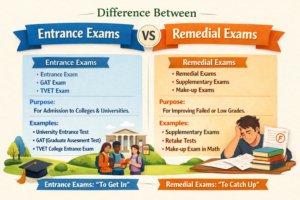
Exams shape students’ futures: they decide university placement, scholarship eligibility, and sometimes job prospects. Two commonly discussed types are entrance exams and remedial exams. They may look similar (both are tests), but they serve very different purposes, follow different rules, and have different consequences for students. This article explains those differences clearly, using Ethiopian practice and examples where appropriate, and offers practical guidance for students, parents, and educators.
Short definitions
Entrance Exam—a test used to determine whether a candidate qualifies for admission to a program in a university. Entrance exams typically select the best-prepared candidates and may be used alongside school grades and quotas. LearnEthiopia hosts many entrance-exam preparation resources (mock tests and subject bundles) illustrating the standard format and topics for such exams.
Remedial Exam—a test (or a set of tests) designed to give students who did not meet the required threshold on the main/first exam another chance to qualify or to demonstrate competency after extra instruction. In Ethiopia, remedial programs were introduced to provide an alternative pathway for students who fell short of standard cutoffs in the national/grade-12 exams, allowing some to re-enter the selection process for university placement.
Purpose and educational intent
-
Entrance Exam: Primarily selection. It ranks or filters applicants. Example: an entrance exam for a specific university faculty or a national university admission test that decides which applicants get the limited seats. The exam is designed to measure readiness for the next level of study.
-
Remedial Exam: Primarily remediation and second-chance assessment. It aims to bring students up to the minimum standard through targeted instruction (remedial classes, extra tutoring), and then evaluate whether the student has reached competency. In Ethiopia, remedial programs are explicitly framed to offer such second chances for those who scored below standard cutoffs but above a minimum threshold.
Who is eligible?
-
Entrance: Anyone who fulfills the exam’s eligibility rules (e.g., completed prior schooling, paid fees, submitted required documents). Eligibility often depends on grade-level completion, minimum grade, or age requirements set by the institution running the entrance exam.
-
Remedial: Restricted to candidates who narrowly failed to meet entrance thresholds but met the remedial program’s minimal criteria (for example, scoring above a set lower bound). Ethiopian Ministry announcements and news reports show remedial participation rules that attempt to balance fairness (who gets a second chance) with standards maintenance. For example, the ministry set percentage and subject-level boundaries for who could join the remedial track.
Timing and frequency
-
Entrance Exams: Usually scheduled once per admission cycle (annual), depending on the institution or national calendar. Preparation and announcement timelines are publicized well ahead to allow applicants to register and prepare.
-
Remedial Exams: Often take place after main exam results are released and after a period of remedial instruction. The remedial cycle in Ethiopia typically runs after the national exam season and may include specific class periods or short crash courses followed by a final remedial test. The ministry and local universities announce the remedial exam schedule when they release results and remedial program details.
Format and content
-
Entrance: Designed to test the curriculum and competences needed for success at the next level. Formats are objective (multiple choice). Official prep providers offer mock tests mirroring entrance exam formats.
-
Remedial: Focuses on core weaknesses identified in the original exams. Content may be narrower (key subjects) and tailored to bring students up to minimum competency. Remedial assessments may emphasize mastery of fundamental concepts rather than higher-order or elective topics. Prep platforms and course bundles for remedial exams show concentrated content and many practice items on core subjects.
Stakes and outcomes
-
Entrance Exam: Outcomes are typically binary for selection—pass and gain admission, or fail and miss admission (though many systems use ranks and cutoffs rather than absolute pass/fail). Performance may also affect the course and university.
-
Remedial Exam: Passing a remedial exam can restore eligibility for admission (or partial admission) or allow students to join conditional programs. Failure in remedial may close the second-chance route, leaving students to seek private colleges, private repeats, or non-degree training. Ethiopian policy documents and reporting show remedial passes are used to award limited seats and to maintain minimum academic standards.
Examples (Ethiopia-focused)
-
University Entrance (typical “entrance exam” example): A student sits the national grade-12 exit exam, and their score, together with any faculty-specific entrance tests or aptitude exams, determines whether they qualify for a public university program. Prep courses for entrance exams include wide-ranging mock tests covering many subjects.
-
Remedial Program for Grade-12 Graduates: Suppose the ministry sets a university cut-off of 50% overall but also allows students who scored between a lower bound (e.g., 33%) and the cut-off to enter a remedial program. Those students study in remedial classes and then take a remedial exam; passing may allow them to be placed in degree programs or in limited seats under remedial quotas. This is the model the Ethiopian remedial program used after recent national exam reforms.
Preparation strategies—how they differ
-
For entrance exams: Broad syllabus coverage, timed practice tests, higher-level problem-solving, simulated exam conditions, and attention to ranking strategies (e.g., maximizing raw marks in high-weight subjects). Resources include comprehensive mock tests and full-subject courses.
-
For remedial exams: Diagnostic testing to identify weak topics, targeted remedial classes, mastery-based practice, frequent short quizzes, and focus on minimum competency. Remedial prep products often provide large banks of basic-to-intermediate questions and short review lessons.
Practical advice for students and guardians
-
Check eligibility and deadlines: Entrance and remedial rules differ; read official announcements from the Ministry or the admitting institution.
-
Choose the right preparation: Use broad mock tests for entrance and concentrated fundamentals for remedial.
-
Document everything: Remedial programs sometimes require application to a special list or proof of scores—keep exam slips and official notices.
-
Manage expectations: Remedial routes are a second chance, not an automatic seat. Understand the cutoffs and probabilities. Recent reporting shows remedial programs can be competitive and subject to administrative challenges.
Conclusion
Entrance exams and remedial exams are complementary parts of an education system: one selects candidates ready to proceed, and the other provides a carefully structured second chance for those who narrowly miss the mark. Both are high-stakes for students and require the right preparation strategy. In Ethiopia’s evolving system, remedial programs are playing a growing role in widening access while trying to preserve academic standards—so students and families should stay informed through official Ministry announcements and trusted preparatory resources (for example, the course and mock-test offerings on LearnEthiopia).