Top Scholarships for Ethiopian Students—Complete Guide, links & application tips
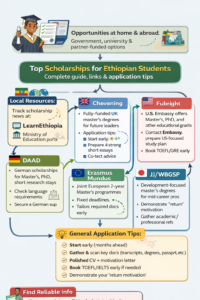
If you’re an Ethiopian student planning to study at home or abroad, there are many scholarships you can aim for—from government-funded awards to university and development-partner scholarships. Below I’ve collected the most useful, regularly available programs, linked to official pages, and given concrete application tips so you can plan and apply with confidence. I also point to useful local resources (including LearnEthiopia and the Ethiopian Ministry of Education) where you can track announcements and country-specific guidance.
Quick overview (what’s here)
Prestigious national & international scholarships: Chevening (UK), Fulbright (USA), DAAD (Germany), Erasmus Mundus Joint Masters (EU), Joint Japan/World Bank Graduate Scholarship (JJ/WBGSP), and other widely available national/uni awards.
Local portals and news you should watch: LearnEthiopia (scholarship category) and the Ministry of Education (MoE) portals for government updates.
1) How to use this guide
Read the short summary of each scholarship below.
Click the citation links (these point to official pages or reliable portals).
Use the “Application tips” after each entry—short, actionable items you can do this week.
Bookmark LearnEthiopia’s scholarship page and the MoE study/announcements pages for Ethiopia-specific calls.
2) Chevening Scholarships (United Kingdom)
What it is: Chevening is the UK government’s flagship fully funded scholarship for one-year master’s degrees for future leaders. It covers tuition, living allowance, airfare, and more. Eligibility is competitive and aimed at professionals with leadership potential.
Who should apply: Graduates with strong academic records, leadership experience, clear career plans, and English language ability.
Application tips
Read the country page and timeline carefully; Chevening runs annual cycles, and each country has interview stages. Start preparing your personal statements and leadership examples early.
Prepare four strong short essays (career plan, leadership, networking, and why the UK)—Chevening uses these to shortlist for interviews. Draft, get feedback, and refine.
Get at least two credible references (academic or professional) that can speak to achievements and leadership.
Where to apply / official info: Chevening country page and application portal.
3) Fulbright (United States)—for Ethiopians
What it is: Fulbright offers a range of awards (master’s, PhD, visiting research, and scholar exchanges) through the U.S. Embassy in Ethiopia. Grants often include tuition, living stipends, and travel.
Who should apply: Strong academic records, clear research or study plans, and (for many awards) a good command of English and relevant standardized test scores where required.
Application tips
Contact the U.S. Embassy’s Education/Exchange office (they often hold info sessions) and follow country-specific instructions on deadlines and local documentation.
Prepare a project or study statement tied to U.S.-Ethiopia links (why this program matters for your country and career).
If test scores are required (e.g., TOEFL, GRE), book them early and use prep resources — some Fulbright tracks waive tests under conditions, but don’t assume that.
Where to apply / official info: Read the U.S. Embassy Ethiopia educational exchange pages and the Fulbright country pages.
4) DAAD Scholarships (Germany)
What it is: DAAD funds a wide range of scholarships (Master’s, PhD, short research stays) to study in Germany. There are programmes targeting development-oriented fields and also university-specific scholarships. DAAD maintains a local Ethiopia office and searchable scholarship database.
Who should apply: Students with a relevant bachelor’s degree, professional experience for some programmes, and motivation to study in Germany.
Application tips
Use DAAD’s scholarship database to filter for eligibility and deadlines. Many DAAD programmes require German or English proficiency — check language requirements early.
Prepare a concise research/study plan and secure a possible supervisor or supporting university if required.
If you need a visa, budget time for German visa processing after selection.
Where to apply / official info: DAAD Ethiopia and the DAAD scholarship database.
5) Erasmus Mundus Joint Masters (European Union)
What it is: Multiple European universities collaborate to offer two-year Master’s programmes; scholarship winners receive tuition, monthly stipend, travel and insurance. These are highly competitive but generous.
Who should apply: High-performing bachelor’s graduates who want a pan-European study experience and can meet strict entry criteria.
Application tips
Check the specific Erasmus Mundus consortium page for required documents (CV, transcripts, motivation letter, references). Deadlines are fixed and strict — missing them means waiting a year.
Tailor each motivation letter to the consortium’s profile and demonstrate readiness for mobility (ability to study in multiple countries).
6) Joint Japan/World Bank Graduate Scholarship Program (JJ/WBGSP)
What it is: A competitive scholarship for mid-career professionals from developing countries to pursue development-related Master’s degrees at partner universities. It’s fully funded (tuition, living allowance, travel).
Who should apply: Applicants with at least two years’ relevant work experience in development, strong academic record, and commitment to returning to their home country.
Application tips
Gather strong professional references and a clear statement of how the degree will contribute to Ethiopia’s development priorities. Deadlines are annual and many eligible applicants miss small paperwork details.
7) Other useful scholarships & country programmes
Global Korea Scholarship (KGSP) — South Korea undergraduate/graduate scholarships; LearnEthiopia has covered recent openings.
Country or university-specific scholarships — many universities in Canada, Australia, China (CSC scholarships), Japan (MEXT), Turkey (Türkiye Scholarships) and India offer Ethiopia-eligible awards. Use aggregators like Scholars4Dev and ScholarshipTab to find rolling calls.
8) Local resources & how to stay updated
LearnEthiopia regularly posts national and international scholarship calls and guidance — bookmark their scholarship category and subscribe for updates.
Ethiopian Ministry of Education (MoE) portals and study platforms sometimes post official opportunities and guidance for students; keep an eye on MoE announcements and education sector pages.
9) General application checklist & winning tips (actionable)
Start early. Many programmes have deadlines months in advance. Create a calendar for each target scholarship.
Documents ready: scanned transcripts, degree certificates, passport copy, CV, reference letters (ask referees early).
Polish your CV and motivation letter. Use concrete achievements and measurable impact (e.g., “led a team of 10 to…”). Tailor to each program.
References: Give referees a short brief on the scholarship and your goals so they write tailored letters.
Language tests & visas: check whether TOEFL/IELTS/GRE are required and schedule tests early. Familiarize yourself with the visa steps for the target country.
Demonstrate ‘return motivation’ where required: many development scholarships want to see how you’ll use the degree in Ethiopia. Be specific about roles, sectors, or institutions.
Use local support: contact the culture or education section of embassies (some hold info sessions), university international offices, and the MoE’s education exchange desks.
10) Final checklist before you hit “submit”
Read eligibility one more time (citizenship, degrees, work experience).
Confirm the required documents and file formats (PDF, notarized copies?).
Get a trusted reviewer to read your essays (mentor, lecturer, scholarship alum).
Make clean backups of every submitted document and note the application reference numbers.