Impact of Digital Education in Ethiopia
Digital education is reshaping how Ethiopians learn, teach, and access opportunities. Over the last decade—and especially since COVID-19—Ethiopia has invested in online platforms, teacher training, connectivity projects, and national strategies to bring digital learning to students across the country. This article examines the positive impacts already visible, the practical challenges that remain, and policy and programmatic steps that can make digital education more equitable and effective in Ethiopia. It draws on Ethiopia’s Ministry of Education initiatives and national platforms, recent World Bank and UNESCO analyses, and local EdTech providers such as LearnEthiopia.
1. What we mean by “digital education”
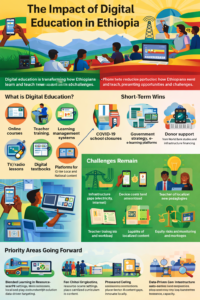
Digital education covers a wide range of approaches: online courses and video lessons, radio and TV-based instruction, learning-management systems (LMS), teacher digital-pedagogy training, digital textbooks, assessment platforms, and the infrastructure that supports them (connectivity, devices, electricity, and platforms). In Ethiopia’s context, digital education also includes government-led online study portals and private/local platforms that supplement classroom teaching and exam preparation.
2. Rapid drivers: why digital learning accelerated in Ethiopia
Three major forces pushed digital education forward in Ethiopia:
COVID-19 school closures — Like many countries, Ethiopia used radio, TV and online resources to reduce learning loss and maintain continuity. This emergency shift exposed both the potential and the gaps of EdTech in Ethiopia.
National strategies and platforms — The Ministry of Education and partners launched digital-learning platforms and strategy documents (including e-learning pilots in higher education and a national digital education strategy) to institutionalize remote and blended learning.
Donor and multilateral support — World Bank and other development partners have funded studies, teacher training programs, and infrastructure projects that aim to scale digital pedagogies and content.
3. Positive impacts observed so far
3.1 Increased access to learning resources
National online platforms and private providers (for example, LearnEthiopia) have made course materials, exam preparation content, and teacher guides more widely available — often free or low-cost — to learners who cannot easily reach physical libraries or coaching centers. This expands access for urban and semi-urban students and those preparing for competitive exams.
3.2 Continuity of learning during disruptions
During school closures, radio and TV broadcasts and online lessons helped reduce the scale of disruption. These channels provided a stopgap so learners could continue some schooling when classrooms were closed. The emergency response highlighted how low-tech and high-tech solutions complement one another in Ethiopia.
3.3 Teacher capacity and new pedagogies
Efforts to build “digital pedagogical skills” for teachers (studied and supported by World Bank teams) are helping teachers design lessons that integrate multimedia resources, formative digital assessment, and blended learning approaches — improving lesson variety and student engagement where devices and connectivity exist.
3.4 Potential for localized, scalable content
Digital platforms enable the creation and distribution of localized content in local languages and the possibility to rapidly update curricular materials. This is particularly useful in multilingual Ethiopia, where regionally relevant content improves comprehension and cultural relevance. National strategies explicitly encourage this direction.
3.5 Data for decision-making
Digital platforms and learning-management systems can collect anonymized usage and assessment data that help planners spot learning gaps, measure reach, and target interventions—a potential boon for evidence-based policy in a large and diverse country. The World Bank and partner projects have emphasized the value of such data for planning.
4. Persistent challenges that limit impact
4.1 Infrastructure and electricity gaps
Many rural and remote areas in Ethiopia still lack reliable electricity and internet. Without stable power and connectivity, students cannot sustainably benefit from online lessons or interactive platforms. Investments in electricity and rural connectivity are therefore essential complements to EdTech. Recent World Bank financing for power expansion is relevant here.
4.2 Device access and affordability
Even where networks exist, the cost of smartphones, tablets, or laptops is prohibitive for many households. Programs that rely on personal devices risk widening inequality between students who have devices and those who do not. Low-tech channels like radio/TV are still critical for inclusion.
4.3 Teacher readiness and workload
Training teachers in digital pedagogy is necessary but not sufficient. Teachers also need ongoing technical support, time to redesign lessons, and incentives to adopt new methods. Studies show that short training without follow-up mentoring often produces limited classroom change.
4.4 Content quality and localization
High-quality digital content aligned to national curricula and produced in appropriate local languages is still limited. Many platforms provide material primarily for exam preparation or urban learners; broader curriculum-aligned content for early grades and marginalized communities needs expansion.
4.5 Monitoring, evaluation and equity risks
Digital rollout without careful monitoring risks reinforcing existing inequalities. If richer schools or regions get the best infrastructure and content first, the digital divide could widen. The evidence base in Ethiopia is still growing and requires sustained evaluation to ensure inclusive scale-up.
5. Where digital education can deliver the biggest value (priority areas)
Blended learning in resource-scarce settings—Combine radio/TV with smartphone-accessible resources and community learning hubs to reach students without home internet. Evidence shows blended approaches reduce exclusion.
Teacher professional development with mentorship—Scale programs that pair short training with long-term coaching, peer support, and practical classroom follow-up. The World Bank’s teacher digital skills work highlights this as high-impact.
Localized curriculum content—Invest in high-quality digital content in local languages aligned to the national curriculum and adapted to different grades (especially early grades). The Ministry’s platforms and national strategy support this direction.
Plug-and-play low-bandwidth solutions—Design platforms and assessments that work offline or on low-bandwidth networks, plus distribution of preloaded devices or memory cards where connectivity is weak.
Data-driven targeting—Use platform analytics to identify learning loss patterns and target remedial programs to the students and regions that need them most.
6. Roles: government, private sector, donors, communities
Government (Ministry of Education): Set standards, fund national platforms, and coordinate connectivity and content policies. The ministry’s online study portal and national strategy are key public assets.
Private EdTech and local platforms: Fill content, delivery, and last-mile innovation gaps (e.g., exam prep, vocational training). Platforms like LearnEthiopia already operate locally and can complement public offerings.
Donors and multilaterals: Finance infrastructure and teacher capacity projects, provide technical assistance, and fund rigorous evaluations. World Bank studies and financing have supported these areas.
Communities and schools: Operate community learning hubs, manage device-sharing programs, and support learners with parental engagement and local language content.
7. Practical recommendations (short-term and medium-term)
Short-term (0–18 months)
Strengthen low-bandwidth channels (radio/TV + downloadable content).
Launch nationwide teacher mentoring pilots that pair digital training with classroom coaching.
Expand and publicize the Ministry’s free online study resources, ensuring easy navigation and offline access.
Medium-term (18 months–4 years)
Invest in rural connectivity and reliable school electricity, leveraging national power and connectivity projects.
Build a national repository of curriculum-aligned, localized digital content (multilingual) and incentivize private partners to contribute.
Create a data-governance framework for learning analytics that protects privacy while enabling evidence-based targeting.
8. Conclusion—realistic optimism
Digital education in Ethiopia is neither a magic bullet nor a distant dream—it is a practical set of tools that, when combined with investments in teachers, power, connectivity, and high-quality localized content, can significantly improve access, continuity, and the relevance of learning. The Ministry of Education’s platforms and national strategy, plus international studies and funding, show the path forward: inclusive, blended approaches; teacher-centered capacity building; and careful, data-driven scale-up. If Ethiopia sustains coherent policy, partners, and financing, digital education can help accelerate learning outcomes across regions and communities—while keeping equity at the center.
Selected sources and further reading
Ministry of Education—Online Study Platform (national platform).
LearnEthiopia—a national/local EdTech platform (courses, exam prep).
World Bank— “Digital Technologies in Education, Health …” report and teacher digital skills study.
UNESCO & ILO discussion papers on digitalization in teaching and education in Ethiopia and neighboring countries.