
Common Mistakes Students Make in the Ethiopian GAT (NGAT)—and How to Avoid Them
Introduction—what the GAT/NGAT is (short recap)
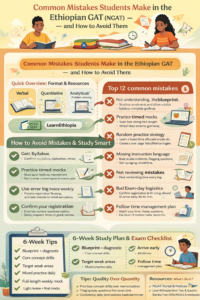
The Graduate Admission Test (often called GAT or NGAT in Ethiopia) is a standardized aptitude test used for admission into many graduate programs. It typically covers verbal reasoning, quantitative reasoning, and analytical reasoning; is delivered under strict rules; and is used by universities to screen applicants for MSc/PhD and other postgraduate courses. Knowing the exam’s purpose and format is the first step in avoiding common mistakes.
Flow of this article
Quick overview of the exam format and study resources you can use.
The most common mistakes students make (practical list).
Detailed “how to avoid” steps and study habits for each mistake.
A ready-to-use 6-week study plan and final exam-day checklist.
Short closing tips and recommended resources.
Quick overview: format & resources (why this matters)
Most GAT/NGAT preparations and mock banks emphasize three sections—verbal, quantitative, and analytical/problem-solving—usually including MCQs with time limits and negative marking policies varying by institution. Practice materials (mock tests and question banks) are widely available online from both public and private preparatory sites; some platforms (including LearnEthiopia) publish curated GAT question banks and mock tests that follow the exam blueprint. Knowing the common item types and practicing timed mock tests are essential.
Top 12 common mistakes—at a glance
Not understanding the test blueprint (what topics and item types appear).
Weak time management—too slow on some sections, rushing others.
Poor practice strategy—random studying without full-timed mocks.
Over-reliance on memorization rather than reasoning skills.
Ignoring instructions & question wording (e.g., “most appropriate,” “except”).
Skipping review of wrong answers (not learning from mistakes).
Bad exam-day logistics—not checking registration, center, or required IDs.
Test anxiety and poor mental pacing—letting one hard question derail you.
Not practicing on a computer/digital interface if the exam is computer-based.
Poor vocabulary and reading habits for the verbal section.
Weak basic math foundations (algebra, ratios, percentages) for quantitative items.
Failing to simulate real exam conditions (timing, breaks, silence).
Each of these causes lost marks that are avoidable with deliberate practice. The next sections break them down and give actionable remedies.
Mistake 1—Not understanding the blueprint
Why it hurts: You may waste time studying irrelevant subtopics or fail to allocate time correctly for sections.
How to avoid:
Get an official or reputable syllabus/blueprint from the NGAT portal or university notices and mark the high-weight topics.
Create a one-page “exam map” that shows section names, number of questions, and typical time per section. Use this map to plan study hours per topic.
Mistake 2—Poor time management
Why it hurts: Many candidates know the material but run out of time.
How to avoid:
Practice timed sectional mocks (not just untimed practice). Start by doing half-length timed sections, then scale up to full-length.
Learn a basic time allocation rule (example: if 125 questions in 180 minutes, roughly 1.4 minutes per question—but adjust by section difficulty). Use a watch or the test interface timer to watch the remaining time every 15–20 questions.
Mistake 3—Random practice instead of deliberate practice
Why it hurts: Random practice gives experience, but not targeted skill improvement.
How to avoid:
Use spaced repetition for weak topics. Keep a log of question types you fail and review them weekly.
After every mock test, make a corrective list: “Top 5 errors—why—how to fix,” and implement those fixes in the next week.
Mistake 4—Memorization over reasoning
Why it hurts: GAT favors logic and reasoning; novel items appear that test concepts, not facts.
How to avoid:
Practice explaining answers (out loud or in writing): Why is this option correct? Why are the others wrong?
For quantitative problems, focus on conceptual steps: set up the equation, estimate answer ranges, then calculate.
Mistake 5—Missing subtle instruction language
Why it hurts: Words like “except,” “most likely,” or “closest” invert expected answers.
How to avoid:
Train yourself to underline key words in the question stem. Make that a habit during every practice question.
When you read a question, paraphrase it in a short clause before answering.
Mistake 6—Not reviewing mistakes properly
Why it hurts: Repeating the same errors wastes study time.
How to avoid:
Maintain an error log (spreadsheet or notebook) with the question, your answer, the correct answer, the error reason, and the fix. Review this log twice weekly.
Re-solve wrong problems after 3 days and again after 2 weeks to lock learning.
Mistake 7—Bad exam-day logistics
Why it hurts: Missing IDs, incorrect centers, or registration issues can block you from taking the test or cause stress.
How to avoid:
Confirm registration, test center, date, and allowed materials two weeks before exam day. The NGAT portal and official notices publish registration procedures—follow them exactly.
Pack your exam kit (ID, printout, permitted supplies) the night before.
Mistake 8—Letting anxiety take over
Why it hurts: Panic slows thinking and causes careless mistakes.
How to avoid:
Practice breathing and 60-second reset routines: if stuck on a question for >3 minutes, mark it and move on; return later.
Simulate full-length exams weekly to build endurance; after each simulation, practice a short relaxation routine.
Mistake 9—Not practicing the delivery format
Why it hurts: If the test is computer-based and you’ve only used paper, UI quirks can cost time.
How to avoid:
Do at least two full mock tests on a computer in a similar browser or platform. Practice changing answers, flagging questions, and using on-screen tools.
Mistake 10—Weak reading and vocabulary habits
Why it hurts: Verbal reasoning depends on quick comprehension and inference.
How to avoid:
Read high-quality editorials, practice cloze and critical-reasoning items daily, and maintain a vocabulary list of unfamiliar words encountered in practice.
Mistake 11—Weak basics in math
Why it hurts: Many quantitative mistakes are avoidable with a quick algebra or arithmetic check.
How to avoid:
Revisit core topics (fractions, ratios, percentage change, basic algebra).
Learn quick estimation and elimination techniques to narrow options before calculating.
Mistake 12—Failing to simulate real conditions
Why it hurts: Low stamina and overconfidence on test day if you’ve never run a full-length timed exam under exam rules.
How to avoid:
Do at least three full, strictly timed mocks in the month before the exam under the same constraints (breaks, silence, no phone). Treat them as practice exams and grade them honestly.
A simple 6-week study plan (practical)
Week 1: Blueprint + diagnostic mock. Make your error log.
Week 2: Core concept drills—quantitative basics and verbal comprehension. Timed mini-sections.
Week 3: Target weak areas identified in the diagnostic. 2 half-length timed mocks.
Week 4: Mixed practice daily (50 Q per day). Continue reviewing the error log.
Week 5: Full-length weekly mock + analyze. Work on pacing strategies.
Week 6: Light review, flashcards, two final full-length mocks. Final logistics check (IDs, center).
Exam-day checklist (printable)
Confirmed admit card/registration on NGAT portal & printed copy.
Valid ID (national ID/passport).
Arrive 45–60 minutes early.
Watch your time: use the sectional pacing plan.
If stuck for more than 3 minutes, mark & move on.
Keep calm—use breathing breaks.
Final tips (practical mindset)
Quality over quantity: 2 truly analyzed mocks are better than 10 untimed practice sets.
Learn to triage questions: an easy-first approach often yields better scores than obsessing over hard questions early.
Consistency: short daily practice beats erratic long sessions.
Suggested resources
Official NGAT/Ministry of Education portal for registration and official notices.
Local GAT preparation platforms and curated question banks (for example, LearnEthiopia’s GAT resources and mock tests).
University and training center guides that publish model tests and blueprints for graduate admission tests.